

Solar CCTV Camera Price in Nigeria: Off-Grid Cameras That Keep Watching
How solar and battery cameras behave in Nigerian sun, dust and rain, when to choose 4G or Wi-Fi, where to put the panel, and what really drives the cost of off-grid CCTV for farms, building sites, remote gates, estates and filling stations.
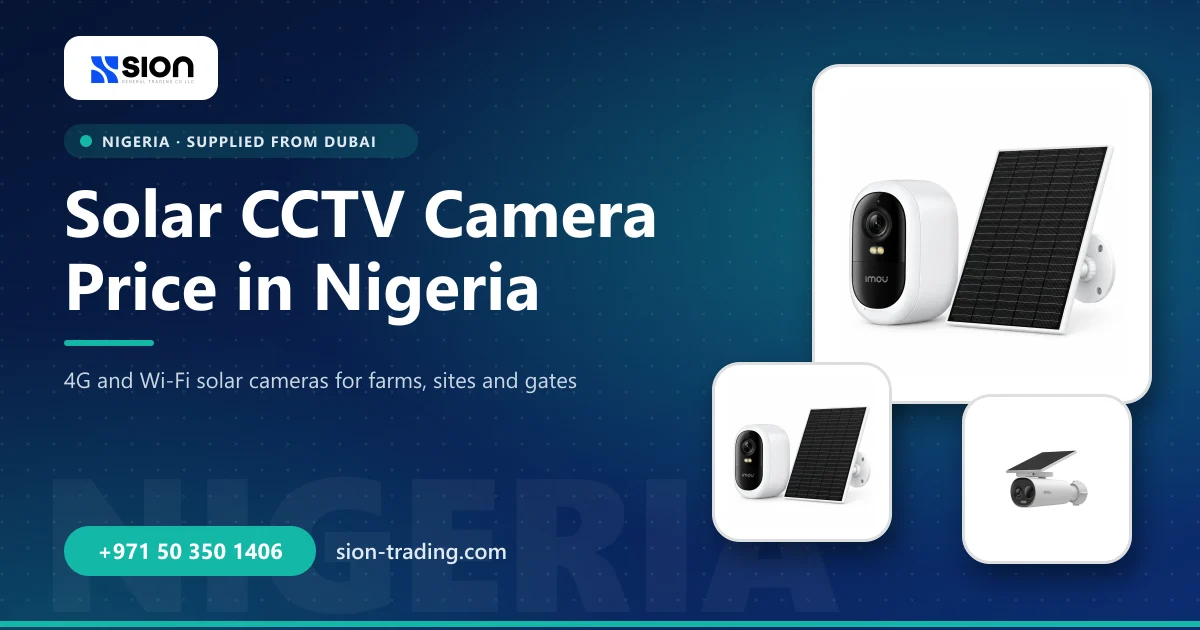
Camera types
Battery kits with solar panels, and 4G cameras for solar power systems
Connectivity
Dual-band Wi-Fi 6 or 4G LTE variants
Battery (AOV Air, Cell 3C)
5000mAh rechargeable
Quick Answer
What affects solar CCTV camera price in Nigeria?
Solar CCTV camera price in Nigeria depends on connectivity (Wi-Fi or 4G), resolution, battery capacity, panel size, night-vision type, recording modes and smart detection, plus microSD cards, data plans, poles and installation. Freight, duties and the naira exchange rate also move the landed cost. Sion General Trading supplies IMOU and Dahua solar-ready cameras from Dubai and quotes each order individually.
Key Facts
- Camera types
- Battery kits with solar panels, and 4G cameras for solar power systems
- Connectivity
- Dual-band Wi-Fi 6 or 4G LTE variants
- Battery (AOV Air, Cell 3C)
- 5000mAh rechargeable
- On-camera storage
- microSD up to 512GB on the AOV Air kits
- Pricing
- Quoted per order; no published price list
- Supplier
- Sion General Trading Co LLC, Deira, Dubai
Overview
Solar CCTV Camera Price in Nigeria: What You Need to Know
Questions about solar CCTV camera price in Nigeria usually come from people guarding places the grid does not reach: a farm outside Abeokuta, a building site in Ibeju-Lekki, a plot on the edge of Abuja, or the back gate of an estate where running power would mean digging up a road. A solar camera solves that by carrying its own battery and charging it from a small panel, and the 4G versions remove the need for network cable as well. The trade-off is energy. Everything the camera does, from recording and night lighting to sending alerts and live video, is paid for from what the panel collects, and Nigerian weather has a say in that.
This guide explains how off-grid CCTV behaves in Nigerian conditions, from harmattan haze in the north to long overcast spells in the southern rainy season, how to choose between 4G and Wi-Fi, where to put the panel, and what actually drives the price. It is written by Sion General Trading Co LLC, a Dubai trading company established in 2023 that supplies IMOU, Dahua and Hikvision surveillance equipment, along with ZKTeco access control, to installers, resellers and project buyers in Africa. Sion ships to Nigeria by sea or air freight and quotes each order individually rather than publishing prices, because landed cost moves with the naira exchange rate.
Sion has no office, shop or installation team in Nigeria. Cameras are mounted by your own technician or a local installer, and Sion helps remotely with app set-up, detection settings and user sharing, then coordinates warranty claims if a unit develops a fault.
Product Showcase
Recommended Products — Solar CCTV Camera Price in Nigeria

IMOU AOV Air 5MP Solar Kit
Wire-free 5MP camera with dual-band Wi-Fi 6, a 5000mAh battery and solar panel, smart full-colour night vision, human and vehicle detection, AOV, timelapse and 24/7 recording modes, microSD up to 512GB and an IP67 rating.
View details
IMOU AOV Air 4G 5MP Solar Kit
The same 5MP AOV Air design with 4G LTE instead of Wi-Fi, so it works on remote gates, farms and plots with no internet at all. Human and vehicle-triggered sirens and spotlights warn intruders off.
View details
IMOU Cell 3C 3MP
3MP all-in-one wire-free camera with a 5000mAh battery, a 2.2W solar panel, PIR plus human detection, a siren and spotlight, and an IP65 rating. An entry option for a gate or doorway near the house.
View details
Dahua Pro 4MP 4G LTE Bullet
4MP 4G LTE bullet with Smart IR up to 60 metres, 120dB True WDR and IP67 housing. It runs on 12V DC and is solar panel compatible, so off-grid use needs a separate panel, charge controller and battery sized by a solar installer.
View details
IMOU Cruiser Dual 2C 4G 6MP
Dual-lens 4G outdoor camera (two 3MP lenses, 6MP in total) with auto cruise, smart tracking, AI human and vehicle detection, red-blue warning lights and microSD up to 512GB or NVR storage. It is not a battery model, so it needs a powered or solar-fed point.
View details
IMOU Cruiser SC 5MP
5MP Wi-Fi pan/tilt camera with 360° coverage, smart colour night vision, red-blue warning lights and a siren. A good fit for a farmhouse or site office that has power, watching the yard while solar cameras guard the edges.
View details
IMOU PS3E 5MP PoE Bullet
Where a gatehouse already has inverter or grid power, a wired 5MP PoE bullet with active deterrence and AI human and vehicle detection removes battery limits altogether and records to an NVR, cloud or microSD.
View detailsFeatures & Benefits
Why Choose Our Solar CCTV Camera Price in Nigeria Solutions
No cable runs to remote points
A wire-free camera with its own battery and panel mounts on a wall or pole with no trenching for power or data, which suits remote gates, plots and fence lines where digging is impractical.
Wi-Fi 6 or 4G variants
The IMOU AOV Air kit comes in a dual-band Wi-Fi 6 version and a 4G LTE version, so each point can use whichever connection the site actually has.
Recording kept on the camera
Footage records to a microSD card in the camera, up to 512GB on the AOV Air kits, so a dropped network connection does not mean lost recordings.
Detection that saves battery
Human and vehicle detection, and the PIR sensor on the Cell 3C, cut false wake-ups from animals, leaves and shadows, which saves both battery charge and mobile data.
Deterrence built in
Sirens, spotlights and customisable alarm sounds on the AOV Air kits warn intruders as they approach, so the camera can discourage a break-in rather than only record it.
Remote set-up help
Sion helps your installer configure the app, detection zones, recording modes and user sharing remotely, Monday to Saturday from 9:00 to 18:00 GST, three hours ahead of Nigerian time.
How a solar powered CCTV camera in Nigeria works
There are two kinds of solar powered CCTV camera in Nigeria. The first is the low-power battery CCTV camera with its own panel, such as the IMOU AOV Air kits and the IMOU Cell 3C. Each holds a 5000mAh rechargeable battery, spends much of its time in a low-power state and is topped up by a small panel. These cameras are quick to install, need no cable runs and store footage on a microSD card. The second kind is a conventional 4G CCTV camera, such as the Dahua Pro 4MP 4G LTE bullet, powered from 12V DC and fed by a separate solar power system: a larger panel, a charge controller and a battery bank sized by a solar installer. That approach costs more and takes more work, but it is not limited by a small internal battery, and on that model it brings infrared reach of up to 60 metres.
Low-power cameras save energy by recording selectively. The AOV Air kits offer an always-on video mode, which is why they are often described as an AOV camera, alongside timelapse and 24/7 recording, together with human and vehicle detection. The Cell 3C combines a PIR sensor with human detection so it wakes for genuine movement. The more continuously a camera records, and the more often it switches on its spotlight or siren, the more energy it uses, so choosing a recording mode is really a decision about how much battery margin you keep for cloudy days.
For most sites the choice follows from the job. Use battery solar kits for spot coverage of gates, sheds, plots and fences where you want alerts and recorded clips. Use a mains-class 4G camera on a properly sized solar power system where you need longer night range, continuous power or several cameras on one pole. Where power already exists, such as a gatehouse on an inverter, off-grid CCTV is unnecessary, and a wired PoE camera is still the most dependable option.
4G solar camera or Wi-Fi: which connection suits your site?
A Wi-Fi solar camera, such as the IMOU AOV Air 5MP Solar Kit with dual-band Wi-Fi 6, needs a usable signal at the mounting point. That suits estate walls, farmhouse compounds and homes where the router is within reach. Test the signal with a phone at the exact spot and height before drilling, because walls, trees and distance weaken it quickly. An outdoor access point can extend coverage, but it needs power of its own, which may defeat the purpose at a truly remote point.
A 4G solar camera, such as the IMOU AOV Air 4G 5MP Solar Kit, carries a SIM card and connects over the mobile network, so it works on remote gates, farms and building sites with no internet at all. Three checks matter. First, test coverage from each network available locally, such as MTN, Airtel or Glo, at mounting height rather than at ground level. Second, confirm that the 4G bands supported by the variant being shipped match the networks at your site; Sion can check the datasheet before you order. Third, use a registered SIM linked to a NIN, as Nigerian rules require, on a data plan that will not lapse unnoticed.
Data use on a 4G camera depends mostly on how you use it. Recording to the microSD card uses no mobile data, while live viewing, playback, clip downloads and frequent alert snapshots all do. An owner who checks in once or twice a day and reviews alerts uses far less than one who leaves a live view running. Draw detection zones carefully, so passing traffic on a road does not trigger a stream of alerts that costs data and battery alike.
Panel placement, harmattan dust and rainy-season cloud
Nigeria lies north of the equator, so a fixed panel generally does best facing roughly south and tilted rather than lying flat. A moderate tilt, commonly at least 10 to 15 degrees, also helps rain rinse dust off the surface. Above all, avoid shade: a water tank, a branch or a parapet that shades even part of a small panel for a few hours a day can cut its output sharply. Walk the site in the morning and late afternoon to see where shadows fall, and remember that trees grow.
In kits like the AOV Air, the panel is supplied as a separate unit, so the camera can point at the gate while the panel faces the sun. Mount the panel high enough to discourage tampering and keep its cable tidy and out of reach. The camera body benefits from some shade: lithium batteries age faster when they bake in direct afternoon sun, so an eave or a small canopy over the camera is worth arranging where you can.
Harmattan dust affects solar cameras twice. The dry north-east wind, which typically blows from around November to March, brings haze that reduces the sunlight reaching the panel, and fine dust that settles on its surface. The effect is strongest in Kano, Kaduna, Sokoto and the rest of the north, but haze reaches Abuja and the south too. Wipe panels with a soft, damp cloth every week or two during harmattan, without abrasive cleaners or pressure washers. The rainy season brings the opposite problem in the south, where Lagos, Port Harcourt and Calabar can see several overcast days in a row. Plan for those weeks by choosing an event-based recording mode, limiting spotlight use and watching battery levels in the app.
How the battery behaves from day to day
A solar camera's battery works like a small bank account. Sunshine pays in; recording, detection, night lighting, Wi-Fi or 4G transmission and live viewing draw out. On a clear day a well-placed panel can replace what a quiet camera uses, while on a dull day in the rainy season it may fall short and the camera draws on its reserve. The 5000mAh battery in the AOV Air kits and the Cell 3C is what carries the camera through those gaps, so the aim is to keep the account in credit across a typical week, not just on a sunny afternoon.
Activity matters more than people expect. A camera facing a busy road, a roosting tree or a flag that flutters all day wakes constantly and drains faster than one watching a quiet gate. Narrow detection zones, human and vehicle filtering and sensible sensitivity settings make the biggest difference. Live viewing is the other heavy user, especially on 4G: watching for twenty minutes every evening costs far more energy than reviewing a few short clips.
Expect behaviour to change with the seasons and as the battery ages. Check the battery level in the app every week for the first month, including at least one spell of poor weather, before relying on the camera. If it struggles, re-angle or move the panel, trim the detection zones or change the recording mode before concluding that the camera is at fault. Where a site needs guaranteed round-the-clock recording, a battery camera is the wrong tool, and a camera on a properly designed solar power system or on mains power is the better choice.
What sets solar CCTV camera price in Nigeria?
Price is driven by connectivity, image quality and energy design. A 4G model generally costs more than its Wi-Fi equivalent and adds a running data cost. Higher resolution, full-colour night vision, human and vehicle detection, deterrence features and two-way audio all push the price up, as do larger batteries and panels. A solar security camera kit that bundles camera, panel and mount can look dearer than a bare camera, but it avoids buying a separate panel that may not match. For mains-class 4G cameras, the solar power system itself, with its panel, charge controller, battery and pole, is a significant part of the budget and should be quoted by a local solar installer alongside the camera.
In relative terms, the entry tier is a 3MP wire-free camera with a small panel, such as the IMOU Cell 3C with its 2.2W panel, for a single gate or doorway close to the house. The mid tier is a 5MP kit with full-colour night vision and AOV recording on Wi-Fi 6 or 4G, such as the IMOU AOV Air kits. The premium tier is a 4G camera such as the Dahua Pro 4MP 4G LTE bullet or the dual-lens IMOU Cruiser Dual 2C 4G on a designed solar power system. Landed cost then adds microSD cards, poles and brackets, freight, duties confirmed by your clearing agent, the naira exchange rate and installation labour.
When comparing solar CCTV camera price in Nigeria quotes, match model numbers, connectivity, battery and panel details, storage and warranty terms, and look out for the warning signs that are common in this category.
- Panel wattage or battery capacity not stated, or figures that do not appear on the manufacturer's datasheet
- '4K' or very high megapixel claims on very cheap kits; with dual-lens cameras, check the per-lens figure, as IMOU does by stating two 3MP lenses for the Cruiser Dual 2C
- Promises of unlimited or 'lifetime' battery life whatever the weather
- 4G cameras whose supported LTE bands are not listed
- No weatherproof rating; look for IP65 or IP67 on outdoor units
- No warranty route, or an app that is not supported in your region
Protecting solar cameras from theft, tampering and hazards
A camera on a pole at a building site or empty plot is a target in its own right. Mount cameras and panels well out of reach from the ground and from wall tops, use tamper-resistant fixings, and position cameras so that each one is visible to another where possible. Use the built-in siren and lights on cameras that have them, and set up notifications so a camera going offline is noticed quickly, because a sudden loss of connection can be the first sign of interference. Remember that footage on a microSD card leaves with a stolen camera, so download important clips promptly.
Some sites need extra care. At filling stations, keep battery cameras and panels out of the hazardous areas around dispensers, vents and tank fill points, follow the station's safety rules and the downstream regulator's requirements, and use solar cameras at the perimeter, office or car wash rather than over the pumps. On farms, make sure livestock cannot reach cables or chew through them. On construction sites, agree with the contractor where cameras can go as scaffolding and walls rise, so coverage moves with the work. Everywhere, put up clear CCTV signs; they deter intruders and help meet data protection expectations.
Wi-Fi or 4G solar camera?
| Aspect | Wi-Fi solar camera | 4G solar camera |
|---|---|---|
| What it needs | A usable Wi-Fi signal at the mounting point | A registered SIM, an active data plan and 4G coverage |
| Best suited to | Homes, estate walls and farmhouse compounds | Remote gates, farms, plots and building sites |
| Running cost | Shares the site's existing internet connection | Ongoing data plan; usage rises with live viewing |
| Main limit | Wi-Fi range through walls, trees and distance | Network coverage and supported LTE bands |
| Check before mounting | Wi-Fi strength with a phone at the exact spot | Signal from each local network at mounting height |
| Example from this page | IMOU AOV Air 5MP Solar Kit (dual-band Wi-Fi 6) | IMOU AOV Air 4G 5MP Solar Kit |
Industries
Who Uses Solar CCTV Camera Price in Nigeria?
Farms and poultry
A solar camera for farms watches gates, feed stores, pens and fish ponds far from the farmhouse, using 4G where Wi-Fi does not reach.
Construction sites
A solar camera for construction sites covers materials yards and site gates before permanent power is connected, and moves as the work progresses.
Undeveloped plots
Owners of land in fast-growing areas such as Ibeju-Lekki, Mowe or the outskirts of Abuja can see who visits a plot without a caretaker on site.
Estate perimeters and remote gates
Back gates, fence lines and drainage channels far from the gatehouse, where trenching for power and data would disrupt residents.
Filling stations
Perimeter, office and car-wash coverage outside the hazardous areas, as a supplement to the station's main wired system.
Warehouses and depots
Outlying fences, container stacks and yard corners beyond the reach of the main CCTV cabling.
New schools and worship grounds
Temporary coverage of new campuses and church or mosque sites during construction, before the permanent system is installed.
How It Works
Our Process, Step by Step
- 01
Survey sun and signal
At each point, check sunlight through the day, shade from trees and walls, and the Wi-Fi or 4G signal at the planned mounting height.
- 02
Choose camera, kit and mode
Match Wi-Fi or 4G, a battery kit or a mains-class camera on solar, and event-based, AOV or continuous recording to what each point must do.
- 03
Get a quote and ship
Sion quotes cameras, kits and accessories per order and ships from Dubai by sea or air, with documents for your clearing agent in Nigeria.
- 04
Mount and angle
Your installer fixes camera and panel high and secure, with the panel facing roughly south and tilted, and the camera shaded where possible.
- 05
Configure and monitor
Sion helps set up the app, detection zones and user sharing remotely; check battery levels weekly through the first month and adjust as needed.
Coverage
Areas We Serve — Nigeria
Lagos and Ogun
Building sites and plots in Ibeju-Lekki, Epe and Lekki, and farms along the Lagos–Ibadan corridor in Ogun, supplied through the Lagos ports or by air.
Abuja and the FCT outskirts
Plots, estates and construction sites in Kuje, Bwari and Lugbe, where harmattan haze is a seasonal factor in panel output.
Kano, Kaduna and the North
Farms and warehouses where the long dry season brings strong sun but heavy harmattan dust, so regular panel cleaning is essential.
Port Harcourt and the South-South
Sites in Rivers, Delta and Cross River, where high rainfall and long overcast spells call for bigger battery margins and careful recording settings.
Oyo, Kwara and the Middle Belt
Farms around Ibadan, Ilorin and Jos, often far from both grid supply and Wi-Fi, where 4G kits are usually the practical option.
Why Sion General Trading
A Dubai Partner for Solar CCTV Camera Price in Nigeria
Dubai-Based Supplier
Sion General Trading Co LLC operates from Al Khabaisi, Deira, Dubai and supplies customers across the UAE, the GCC and Africa.
Genuine Products
Genuine ZKTeco, Hikvision, Dahua and IMOU products supplied with manufacturer warranty and proper documentation.
Technical Pre-Sales Advice
Help choosing devices, controllers, locks and software so the system matches your doors, users, network and budget.
Installation in the UAE
On-site installation, configuration and training across the emirates, with remote setup support for customers abroad.
After-Sales Support
Configuration, software and warranty support by WhatsApp, phone and email during business hours, Monday to Saturday.
Arabic & English
Devices and software set up with Arabic or English interfaces where supported, for bilingual teams and visitors.
FAQ
Solar CCTV Camera Price in Nigeria — Frequently Asked Questions
Yes. The camera runs from its battery, which the panel charges during the day. Night images rely on the camera's own lighting: the IMOU AOV Air kits offer smart full-colour night vision and the Cell 3C has a spotlight. Night lighting uses energy, so a camera that switches its light on many times a night will draw down its battery faster than one watching a quiet spot.
There is no single figure, because it depends on the recording mode, how often the camera wakes, night lighting, live viewing and signal strength. The reliable approach is to test: watch the battery level in the app through a spell of dull weather during the first month, then adjust detection zones, sensitivity or recording mode if the level keeps falling.
It reduces charging rather than stopping it. Haze cuts the sunlight reaching the panel and dust coats its surface. Keep the panel tilted, wipe it gently with a damp cloth every week or two during harmattan, and keep recording settings efficient through the dustiest weeks, particularly in the northern states.
Yes. It needs a registered SIM with an active data plan. Recording to the microSD card uses no data, while live viewing, playback, downloads and alert snapshots do. Choose the network with the strongest signal at the mounting point and confirm the camera's supported 4G bands before ordering, which Sion can check against the datasheet.
The IMOU AOV Air kits offer AOV, timelapse and 24/7 recording modes, but continuous recording uses more energy, so whether the battery keeps up depends on your sunlight and settings. Where continuous recording is essential, a mains-class camera such as the Dahua Pro 4MP 4G LTE bullet on a properly sized solar power system is the more dependable choice.
On a microSD card inside the camera, up to 512GB on the AOV Air kits. If the camera is stolen, the card goes with it, so mount cameras out of reach and save important clips to your phone promptly. Cloud options vary by model and region, so check in the app what is available for your camera.
It depends on how many points you need, Wi-Fi or 4G, resolution, kit type, poles, cards and freight, so Sion quotes per order rather than publishing a figure. Send a sketch of the farm showing gates, stores and pens, their distance from the farmhouse and which points have Wi-Fi, and Sion will suggest a suitable mix and quote it.
Yes, with care. Keep cameras and panels outside the hazardous areas around dispensers, vents and tank fill points, follow the station's safety rules and the regulator's requirements, and use them for the perimeter, office and car wash. Coverage over the pump islands should be designed with the station's safety officer, using equipment suited to its exact location.
No. Sion General Trading supplies the cameras from Dubai and has no office, shop or installation team in Nigeria; its own installation service operates only in the UAE. A local installer or your own technician mounts the cameras, while Sion helps remotely with app set-up and detection settings and coordinates warranty claims after the sale.
Related Searches
- solar powered CCTV camera in Nigeria
- 4G solar camera
- solar CCTV camera
- solar security camera
- battery CCTV camera
- off-grid CCTV
- wire-free camera
- AOV camera
- 4G CCTV camera
- solar camera for farms
- solar camera for construction sites
- harmattan dust
Get a Quotation for Solar CCTV Camera Price in Nigeria
Tell us your requirements — Sion General Trading Co LLC replies with recommended products, availability and a quotation.
Published by Sion General Trading Co LLC, Dubai · Last updated